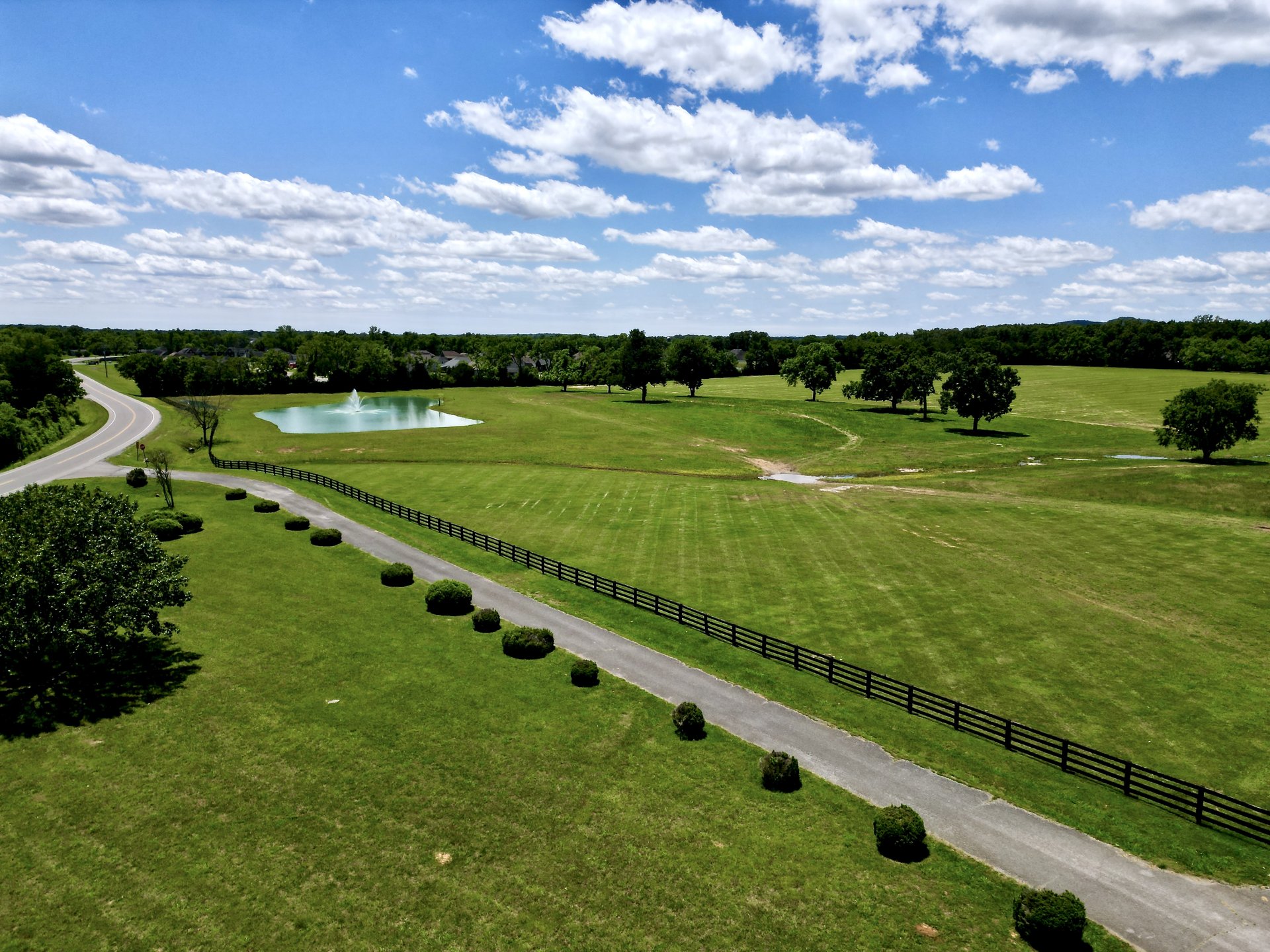
Williamson County is still the price ceiling for Middle Tennessee land — and the gap between Williamson and every county to its south continues to widen. Here is what the trailing three years of verified closings actually show, where the action is concentrated, and where the price you'd be quoted differs meaningfully from the price the data supports.
What the data is telling us
Williamson's per-acre median is shaped less by the county average and more by which high-school zone a tract falls into. Ravenwood and Independence school zones drag the upper percentiles. The Fairview zone — westernmost part of the county — anchors the lower band. School-zone segmentation matters more than tract size at the small end (≤ 5 acres) and roughly as much as size in the 10–30 acre band. By the time you reach 50+ acres, school zone matters less and land features (water, road frontage, conservation potential) start driving the spread.
Where prices are landing
Across 669 verified Realtracs land closings in Williamson County from Nov 2023 – Aug 2026, the median sale price works out to $104K per acre, with the middle 50% of sales between $56K and $195K. The median tract was 6.8 ac and the median sale price $900K. These are county-wide figures; the live Williamson County Land Intelligence page updates them as new closings come in.
Sub-area dynamics
Inside Williamson, four distinct sub-markets are running on different clocks. Franklin and Brentwood proper carry residential infill premium that distorts any per-acre headline number — these are not land markets in the traditional sense. The College Grove / Triune corridor along the I-840 / Highway 41A axis is the county's most active genuine land segment, with steady absorption of 10–50 acre tracts at premium per-acre figures. Nolensville and the southern county fringe price slightly below College Grove but trade faster. Fairview and the western county remain the relative value end — same Williamson school district, dramatically different per-acre cost, more terrain (steeper, more wooded) to work with.
What buyers should watch
Williamson buyers in 2026 should expect listing prices that are pulled toward the 75th percentile of recent comps rather than the median — sellers in this county know the data and price aggressively. The real watchpoints: how long a tract has been on the market (a tract that has sat well past its neighbors is a meaningful signal), whether the listing is in a school zone that has actually been transacting (some zones see only a handful of closings a year — thin), and what the per-acre figure looks like when you back out the house, accessory structures, and any non-land value. The headline list price and the per-bare-acre figure are usually two very different conversations.
What sellers should know
If you're a Williamson seller, the comp set that matters is your school zone and your acreage band — not a county average. We see sellers consistently price either too aggressively (pulling from the top quartile in a different school zone) or too conservatively (anchoring on a 5-year-old sale that no longer reflects the market). Williamson rewards a defensible price: tracts priced within the recent closing band tend to move quickly, while tracts priced above it tend to sit. The county also has more legitimate development-interest buyers than any other Middle Tennessee market, and a well-positioned tract with utility access can attract that buyer pool — which prices off future entitled lot count, not raw acreage.
Bottom line
Williamson is the most data-driven land market in Middle Tennessee and the one where pricing mistakes cost the most. Both buyers and sellers should anchor on the school-zone-and-acreage-band median, then adjust for the parcel's specifics. The county average is misleading because the county is genuinely four or five different sub-markets running in parallel. Pull the comps that match your tract, not the headline figure.
For the live Williamson County dashboard — county price trends, school zones, and zoning overlays — see our Williamson County Land Intelligence page. For the full buyer's guide covering zoning, septic, greenbelt, utilities, and sub-markets, read the Williamson County Land Guide. Or browse all county guides.